The UAE’s manufacturing and industrial sectors are moving quickly toward smarter, faster, and more reliable operations. With national initiatives such as Operation 300bn, which aims to increase the industrial sector’s contribution to GDP from AED 133 billion to AED 300 billion by 2031, factories across the UAE are under growing pressure to improve productivity, reduce downtime, and adopt advanced technologies.
This is where industrial automation companies in UAE play an important role. From PLC control panels and SCADA monitoring to smart sensors, automated machinery, production line upgrades, and preventive maintenance systems, automation helps factories operate with greater accuracy, consistency, and control.
For industries such as food processing, bottling plants, packaging factories, poultry farms, warehouses, metal fabrication, and manufacturing facilities, automation is no longer optional. It has become a key part of improving factory efficiency and staying competitive in the UAE market.
What Is Industrial Automation?
Industrial automation is the use of control systems, sensors, software, machinery, and electrical components to operate factory processes with minimal manual intervention.
It can include:
● PLC control systems
● SCADA monitoring systems
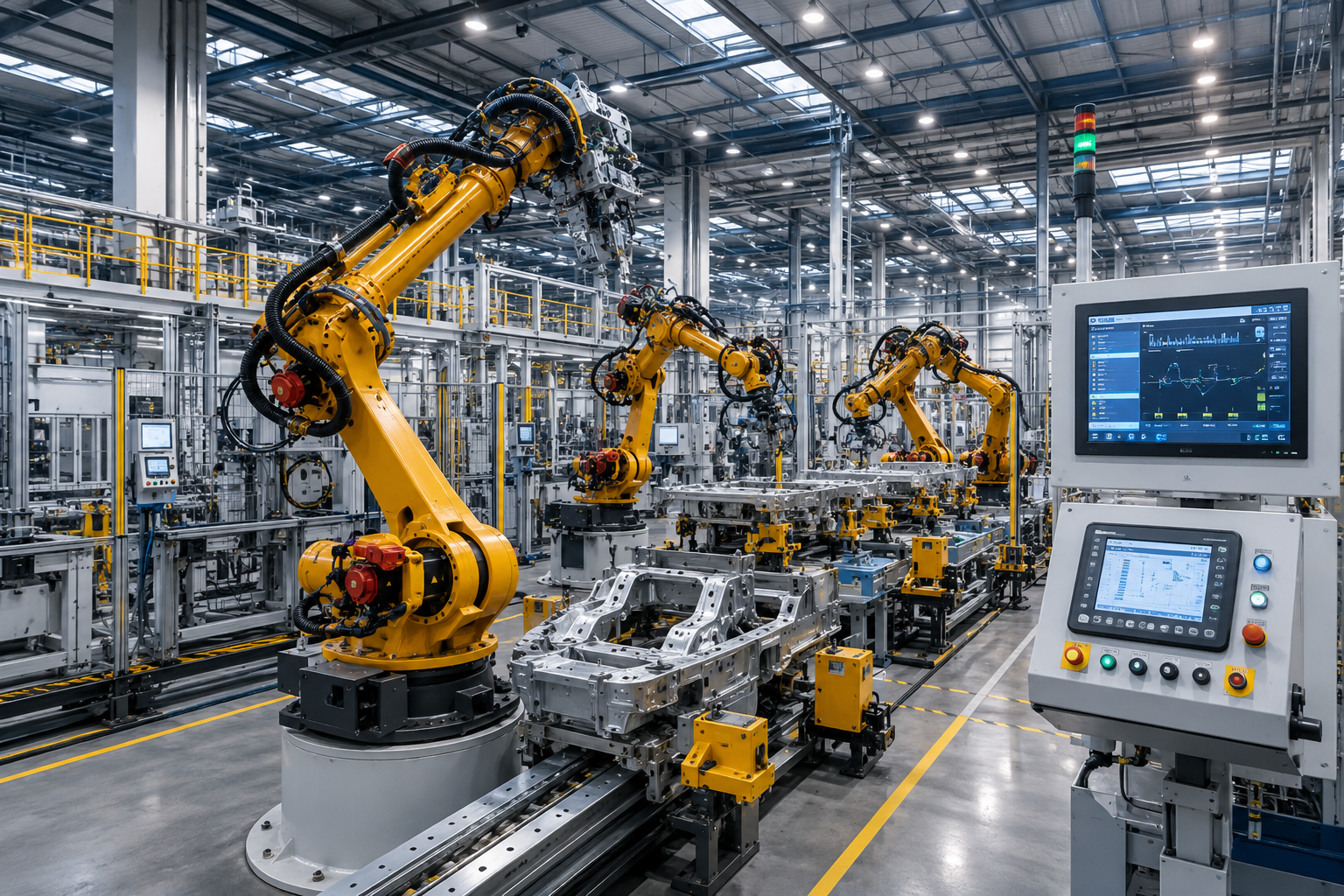
● Automated production lines
● Motor control panels
● Variable Frequency Drives, or VFDs
● Smart sensors and instruments
● Conveyor automation
● Robotic systems
● Remote monitoring
● Predictive and preventive maintenance systems
● Integration between MEP, machinery, and production equipment
In simple terms, industrial automation allows factories to run more smoothly, safely, and efficiently by reducing manual errors and improving process control.
Why Industrial Automation Matters for UAE Factories
The UAE is focusing strongly on advanced technology, digital transformation, and Industry 4.0. The UAE Industry 4.0 program is one of the main pillars of Operation 300bn and is designed to accelerate digital transformation in the industrial sector, improve productivity, and create skilled jobs.
For factory owners and operations managers, this means automation is not only a technical upgrade. It is a business advantage.
Factories in the UAE often face challenges such as:
● High production demand
● Rising energy costs
● Skilled labor shortages
● Equipment downtime
● Quality control issues
● Manual process delays
● Safety risks
● Maintenance inefficiencies
● Lack of real-time production data
Industrial automation helps solve these challenges by connecting machines, systems, and people through smarter control and monitoring.
How Industrial Automation Improves Factory Efficiency in UAE
1. Reduces Machine Downtime
Downtime is one of the biggest losses for any factory. When a production line stops, the business loses time, output, and money.
Automation systems help reduce downtime by monitoring machine performance in real time. Sensors can detect abnormal temperature, vibration, pressure, current load, or motor behavior before a major failure happens.
With proper automation, factories can shift from reactive maintenance to preventive or predictive maintenance. This allows maintenance teams to fix problems early and avoid unexpected shutdowns.
For UAE factories operating in food production, bottling, packaging, or continuous manufacturing, this can significantly improve daily output.
2. Increases Production Speed
Manual production processes depend heavily on operator speed, availability, and accuracy. Automation helps factories maintain a steady production rhythm.
Automated systems can control conveyors, filling machines, packaging lines, mixers, pumps, compressors, chillers, and other equipment with consistent timing and precision.
This improves:
● Production cycle time
● Machine utilization
● Batch consistency
● Output per shift
● Line balancing
● Overall productivity
For example, in a bottling plant, automation can synchronize bottle feeding, filling, capping, labeling, and packaging. This reduces delays between each stage and improves total line efficiency.
3. Improves Product Quality and Consistency
Quality problems often happen when processes are not controlled properly. Variations in temperature, pressure, speed, flow rate, or timing can affect the final product.
Industrial automation improves quality by keeping every process within controlled limits.
In food processing factories, automation can control mixing time, temperature, humidity, conveyor speed, and packaging accuracy. In manufacturing plants, it can maintain precise machine operation and reduce human error.
Automation also supports quality tracking through data logging and process history. This is especially important for industries where hygiene, traceability, and compliance are critical.
4. Reduces Human Error
Even skilled operators can make mistakes, especially in repetitive or high-pressure environments. Manual switching, machine setting, material handling, and process monitoring can lead to errors if not properly controlled.
Automation reduces this risk by standardizing operations.
A well-designed PLC or SCADA system can ensure that machines follow the correct sequence every time. It can also include alarms, interlocks, safety shutdowns, and operator guidance.
This helps factory teams avoid:
● Wrong machine settings
● Overheating
● Overloading
● Incorrect timing
● Process interruptions
● Unsafe equipment operation
● Inconsistent production results
The result is a more reliable and controlled factory environment.
5. Improves Energy Efficiency
Energy consumption is a major operating cost in UAE factories, especially where HVAC, compressors, pumps, chillers, motors, and production machinery run for long hours.
Automation helps reduce energy waste by controlling equipment based on actual demand. For example:
● VFDs can adjust motor speed instead of running motors at full power continuously. ● Smart controls can optimize HVAC operation in production areas.
● Sensors can switch systems on or off based on occupancy, temperature, pressure, or process demand.
● SCADA systems can monitor energy consumption and identify abnormal usage.
This is particularly valuable in UAE industrial facilities where cooling, ventilation, compressed air, and refrigeration systems can consume a large portion of energy.
6. Provides Real-Time Factory Data
One of the biggest advantages of automation is visibility.
Without automation, factory managers may depend on manual reports, operator feedback, or delayed production data. With automation, key information is available in real time.
SCADA and monitoring systems can show:
● Machine status
● Production output
● Energy consumption
● Alarm history
● Downtime reasons
● Temperature and pressure readings
● Motor loads
● Equipment running hours
● Maintenance alerts
This helps managers make faster and better decisions. Instead of guessing where the problem is, they can see the actual performance of the factory.
7. Improves Safety in Industrial Operations
Safety is a major priority in UAE industrial projects. Automation improves safety by reducing direct human contact with hazardous machinery, electrical systems, high-temperature areas, and moving equipment.
Automation systems can include:
● Emergency stop circuits
● Safety interlocks
● Machine guarding integration
● Overload protection
● Alarm systems
● Remote monitoring
● Automatic shutdown logic
● Controlled start-up sequences
For factories with heavy machinery, conveyors, pumps, compressors, and electrical panels, these systems help protect workers and reduce operational risks.
8. Supports Scalable Factory Growth
As production demand increases, factories need systems that can grow with the business. Industrial automation makes expansion easier because machines, panels, sensors, and software can be integrated into a structured control system.
A scalable automation setup allows factories to add:
● New production lines
● Additional machines
● More sensors
● Remote monitoring points
● Energy management systems
● Advanced reporting dashboards
● Integration with ERP or maintenance software
This is especially important for UAE manufacturers planning long-term growth in local and export markets.
Key Industrial Automation Solutions for UAE Factories
Professional industrial automation companies in UAE usually provide a combination of engineering, electrical, mechanical, and control system services.
Common solutions include:
PLC Automation
PLC systems control machines and production sequences. They are used in conveyors, pumps, motors, packaging machines, filling lines, and process equipment.
SCADA Systems
SCADA systems allow operators and managers to monitor factory operations from a central screen. They provide alarms, trends, data logging, and real-time visibility.
Control Panel Design and Installation
Automation panels are essential for safe and organized machine control. These include PLC panels, MCC panels, VFD panels, distribution panels, and custom control panels.
VFD Installation and Motor Control
VFDs help control motor speed, reduce energy consumption, and improve process stability.
Sensor and Instrumentation Integration
Sensors measure temperature, pressure, level, flow, vibration, humidity, current, and other process values.
Machinery Installation and Automation
Automation companies can integrate new or existing machines into a controlled production system.
Preventive Maintenance Systems
Smart monitoring helps maintenance teams track equipment condition, schedule service, and reduce failures.
Industries That Benefit from Industrial Automation in UAE
Industrial automation is useful across many UAE sectors, including:
● Food processing factories
● Bottling plants
● Packaging facilities
● Poultry farms
● Cold storage facilities
● Warehouses and logistics centers
● Manufacturing plants
● Metal fabrication workshops
● Plastic and packaging industries
● Animal feed and stable facilities
● Industrial kitchens
● Pharmaceutical and hygiene product factories
Each industry requires a different automation approach. For example, a food processing plant may need hygiene-focused controls, temperature monitoring, and traceability. A bottling plant may need conveyor synchronization, filling accuracy, and packaging automation. A poultry farm may require ventilation control, feeding systems, humidity monitoring, and environmental automation.
Choosing the Right Industrial Automation Company in UAE
When selecting an automation partner, factory owners should look beyond basic installation. The right company should understand the full industrial environment, including electrical systems, MEP services, machinery, safety, maintenance, and production requirements.
A reliable automation company should provide:
● Site inspection and technical assessment
● Proper system design
● PLC and control logic development
● Electrical panel installation
● MEP and machinery integration
● Testing and commissioning
● Safety compliance
● Maintenance support
● Clear documentation
● Long-term service capability
For factories in the UAE, choosing a technically strong partner ensures that automation is not just installed, but properly integrated into daily operations.
How JBT World Supports Factory Automation in UAE
JBT Building Contracting LLC, known as JBT World, supports industrial clients with engineering-focused solutions for factory construction, MEP systems, automation, machinery installation, and facility maintenance.
JBT World works with industrial environments where reliable execution is critical, including factories, food processing facilities, bottling plants, poultry farms, stables, warehouses, and production facilities.
Our approach focuses on:
● Practical factory automation
● MEP and machinery coordination
● Control panel installation
● Electrical and mechanical integration
● HVAC and utility system support
● Preventive maintenance
● Site-based engineering execution
● Long-term operational reliability
By combining automation with strong MEP and industrial construction expertise, JBT World helps factories improve performance, reduce downtime, and operate with better control.
Conclusion
Industrial automation is transforming the way factories operate in the UAE. It improves production speed, reduces downtime, enhances safety, lowers energy waste, improves quality, and gives factory managers better control over daily operations.
As the UAE continues to invest in advanced manufacturing and Industry 4.0, factories that adopt automation will be better prepared for future growth, competition, and operational efficiency. The UAE’s Fourth Industrial Revolution Strategy also supports the country’s ambition to become a global hub for advanced technologies and innovation.
For factory owners, facility managers, and industrial operators, working with experienced industrial automation companies in UAE is a smart step toward building more efficient, reliable, and future-ready industrial facilities.